1. What Is a Cryptocurrency ATM?
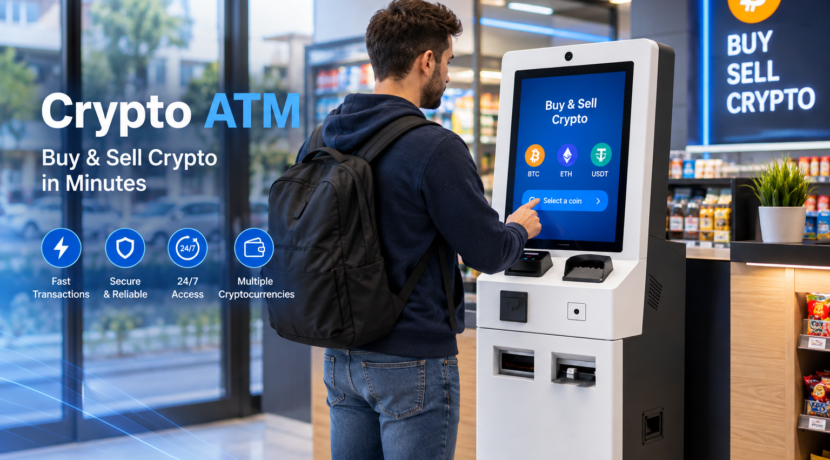
A Cryptocurrency ATM, also known as a Crypto ATM, Bitcoin ATM, or cryptocurrency kiosk, is a self-service terminal that enables users to exchange traditional currency, often cash, for supported digital assets. Depending on the operator’s service model and the machine’s configuration, some terminals may also support selling cryptocurrency and receiving cash.
Unlike a traditional bank ATM, a Cryptocurrency ATM does not normally provide access to a conventional bank account. Instead, it connects the customer to a cryptocurrency service provider or operator platform. The customer follows the on-screen instructions, completes the required identity or compliance checks, selects a supported transaction, and provides a destination wallet address when purchasing cryptocurrency.
The exact services available vary by operator, country, software platform, supported assets, and regulatory permissions. A machine’s hardware capabilities alone do not determine which cryptocurrencies or transaction types can be offered; those functions depend on the operator’s backend service and approved integrations.
2. How Does a Crypto ATM Machine Work?
Although user interfaces differ, a typical cash-to-crypto transaction follows a series of steps.
First, the customer selects a supported language and transaction option on the touchscreen. The interface explains the available service, applicable fees, exchange-rate information, and any transaction limits. Clear instructions are important because customers may be unfamiliar with digital wallets or cryptocurrency transactions.
Next, the customer completes the identity verification process required by the operator and local rules. Depending on the jurisdiction and risk controls, this may involve entering a mobile number, scanning an identity document, taking a photograph, or completing additional verification. The specific process must be configured by the service operator in line with applicable requirements.
After verification, the customer enters or scans a cryptocurrency wallet address, often using a QR code. The customer should carefully check that the address and selected network are correct before proceeding. The customer then inserts cash into the machine’s banknote acceptor. The cash-handling module validates and counts the accepted notes, while the software calculates the transaction amount based on the applicable exchange rate and fees.
Once the customer reviews and confirms the details, the operator’s platform processes the order and arranges delivery of the purchased cryptocurrency to the specified wallet. A receipt or transaction reference may be provided, depending on the configuration. Blockchain confirmation times and network fees can vary, so the machine should communicate transaction status clearly rather than promise an exact completion time.
For a sell-crypto transaction, where supported, the process is different. The customer sends digital assets to an address or service controlled by the operator. After the required confirmations and checks, the system authorizes a cash payout. This requires additional cash-dispensing hardware and carefully designed settlement procedures. Not every Cryptocurrency ATM supports two-way transactions.
3. Why Are Cryptocurrency ATMs Used?
A Cryptocurrency ATM can make digital asset services available through a familiar self-service format. Instead of relying only on a website or mobile application, customers can interact with a physical terminal in a retail environment.
Convenient access is one potential advantage. A well-positioned crypto kiosk can provide access during the host location’s opening hours and guide users through a structured transaction flow. This may be useful for customers who prefer an in-person interface or who want help from clear on-screen instructions.
A second advantage is the familiar cash interface. In markets where cash remains widely used, a cash-accepting Cryptocurrency ATM can connect physical banknotes with a digital asset service. The banknote validator, cash storage, and optional payout components must be selected according to the operator’s transaction model and expected volume.
For operators and retail partners, a crypto ATM may provide an additional service that attracts customer visits and creates a potential revenue stream. Revenue models differ, and operators should evaluate transaction fees, location agreements, cash logistics, service costs, software fees, and regulatory expenses before making a business decision. A machine does not guarantee a particular transaction volume or return on investment.
4. Important Features to Evaluate in a Cryptocurrency ATM
Choosing the right Cryptocurrency ATM requires attention to both the physical kiosk and the software platform behind it. A reliable installation should be designed around the operator’s market, transaction model, and expected usage.
Cash acceptance and validation: For cash-to-crypto services, the banknote acceptor should support the currencies and denominations used in the target market. Operators should confirm validation performance, note handling, reject behavior, cashbox capacity, and the availability of service parts. Local banknote conditions and currency requirements should be considered before finalizing the configuration.
Touchscreen and user experience: The interface should be easy to understand, with readable text, clear instructions, and a logical transaction flow. Multi-language support can be important in locations serving international or multilingual customers. Important information—including fees, exchange rates, limits, and transaction warnings—should be presented before the customer confirms a transaction.
Connectivity and backend integration: A Cryptocurrency ATM relies on communication with the operator’s platform and relevant service providers. Stable network connectivity, secure data transmission, transaction monitoring, and clear error handling are essential. Before deployment, the operator should confirm API compatibility, integration responsibilities, system availability, and how software updates are managed.
Receipt and transaction records: A receipt printer can provide a physical record of key transaction information, where appropriate. Operators should define what information is displayed or printed, how transaction references can be retrieved, and how customer privacy is protected.
Security and physical design: The kiosk should be designed to protect cash-handling components, internal electronics, and service access points. Depending on the location, operators may also consider CCTV coverage, tamper monitoring, secure mounting, and controlled access for maintenance. Physical security should be supported by software controls and operational procedures.
Remote management and maintenance: For operators managing multiple machines, remote monitoring can help teams review device status, identify errors, monitor cash levels where supported, and coordinate maintenance. The actual functions depend on the kiosk hardware and management software. Operators should confirm which data is available remotely and which actions require an on-site technician.
5. Compliance, KYC, and Transaction Security
Compliance is a central part of operating a Cryptocurrency ATM business. The legal classification of an operator, licensing or registration requirements, customer verification obligations, transaction monitoring rules, recordkeeping, and reporting duties vary by country and sometimes by state or region. Operators should obtain advice from qualified legal and compliance professionals before launching or expanding a service.
In the United States, FinCEN has issued guidance highlighting risks associated with convertible virtual currency kiosks and reminding financial institutions to remain alert to suspicious activity. Depending on the business model and applicable law, an operator may have obligations under money services business and anti-money laundering frameworks. Other jurisdictions apply their own virtual asset service provider or money transmission rules. A hardware supplier cannot determine an operator’s legal eligibility simply by supplying a machine.
Know Your Customer (KYC) procedures and Anti-Money Laundering (AML) controls should be designed into the service workflow. Operators may need identity verification, transaction limits, risk scoring, suspicious activity monitoring, record retention, and escalation procedures. Controls should be proportionate to the risks and consistent with local requirements.
Consumer protection also matters. Cryptocurrency transactions may be difficult or impossible to reverse once completed. Customers should receive clear warnings about checking wallet addresses, understanding fees, and avoiding payments requested by unknown callers or online contacts. A legitimate operator should never encourage a customer to send funds to a stranger claiming to represent a government agency, bank, utility provider, or technical support team.
Because requirements change, operators should review local rules regularly and maintain documented compliance procedures. A Cryptocurrency ATM deployment should be treated as a regulated service project where applicable, not simply as a standard vending-machine installation.
6. Where Can a Cryptocurrency ATM Be Installed?
Potential locations include convenience stores, shopping centers, supermarkets, gas stations, and other retail environments with suitable customer traffic. The best location is not necessarily the busiest one. Operators should consider local demand for digital asset services, customer demographics, nearby competition, opening hours, cash-handling arrangements, physical security, internet connectivity, and the host property’s approval.
Before installation, confirm the available floor space, power supply, network connection, access for cash collection and maintenance, and any requirements for anchoring or surveillance. The kiosk should be visible and accessible without obstructing normal store operations. Staff at the host location should understand the basic purpose of the machine and know how to direct customers to the operator’s official support channel.
Location agreements should clearly define responsibilities. For example, the operator and host business should agree on access hours, revenue sharing if applicable, electricity and connectivity arrangements, incident reporting, cleaning, and who is responsible for customer inquiries. These details help prevent operational misunderstandings after launch.
7. How to Plan a Cryptocurrency ATM Business
A practical deployment starts with market research. Identify the target region, review local regulations, understand customer payment preferences, and estimate realistic transaction demand. Speak with potential host locations and assess whether the business model can cover the costs of equipment, software, cash logistics, compliance, insurance, maintenance, and customer support.
Next, define the transaction model. Will the machine support cash-to-crypto purchases only, or will it also offer crypto-to-cash sales? Which currencies and denominations are required? Which digital assets and blockchain networks will the operator support? Which identity verification provider, liquidity source, wallet infrastructure, and payment or exchange partners will be used? These are primarily operator-platform decisions and should be clarified before hardware specifications are finalized.
Then select a hardware configuration that matches the service. Consider the touchscreen size, banknote acceptance capacity, cash storage, optional cash dispensing, printer, scanner, enclosure, and service access. Ask the manufacturer to confirm the supported components and provide clear documentation of interfaces and integration requirements.
Before public launch, conduct end-to-end testing. Test banknote acceptance, transaction initiation, wallet QR scanning, identity verification, backend communication, exchange-rate display, fee calculation, receipts, error recovery, and remote monitoring. If the machine supports cash payout, test payout accuracy, cash-level alerts, and replenishment procedures as well. A controlled pilot can reveal issues before the operator expands to additional locations.
Finally, prepare an operating plan. Define cash collection frequency, reconciliation procedures, incident response, customer support, software maintenance, security checks, and performance reporting. A repeatable operating process is especially important when managing a network of Cryptocurrency ATM machines across multiple locations.
8. Choosing a Cryptocurrency ATM Manufacturer
A manufacturer should be able to discuss the project as a complete kiosk deployment rather than focusing only on the cabinet. Ask about the cash-handling components, supported banknote denominations, touchscreen and printer options, enclosure customization, network interfaces, documentation, testing, production lead time, warranty, spare parts, and technical support.
It is equally important to separate hardware responsibilities from operator software responsibilities. The manufacturer may supply the kiosk and integrate agreed peripherals, while the operator or its technology partner supplies the cryptocurrency platform, wallet services, exchange connectivity, KYC tools, and transaction processing. These responsibilities should be documented clearly before an order is placed.
For projects intended to scale, consider whether the hardware design can be maintained consistently across multiple units and locations. Standardized components, accessible service points, clear technical documentation, and reliable after-sales support can make a meaningful difference to long-term operation.
A suitable Cryptocurrency ATM solution is one that matches the operator’s service model, local market requirements, and technical ecosystem. Careful planning at the beginning can reduce integration delays and make future expansion more manageable.
Frequently Asked Questions
What is the difference between a Bitcoin ATM and a Cryptocurrency ATM?
A Bitcoin ATM is a type of Cryptocurrency ATM that supports Bitcoin. The broader term Cryptocurrency ATM may refer to a kiosk that supports Bitcoin and other digital assets, depending on the operator’s platform.
Can a Cryptocurrency ATM buy and sell cryptocurrency?
Some machines support purchases only, while others support both buying and selling. Two-way service requires the appropriate software, liquidity and settlement arrangements, and cash-dispensing hardware for cash payouts.
Does a Cryptocurrency ATM connect directly to a blockchain?
The kiosk generally communicates with an operator’s backend platform and service providers. The platform coordinates the transaction and blockchain interaction. The exact architecture depends on the operator’s software and integrations.
Can a Cryptocurrency ATM support different currencies?
The cash acceptor can be configured for selected fiat currencies and denominations, subject to the hardware model and validation components. The operator must also ensure that the service is permitted and properly supported in the target market.
Is a Cryptocurrency ATM business regulated?
It may be. Requirements depend on the country, region, transaction model, and services offered. Operators should obtain local legal and compliance advice before operating a machine or accepting customer funds.
What should an operator check before buying a crypto ATM machine?
Review local compliance requirements, the operator software, supported assets and networks, cash-handling capacity, identity verification workflow, security, remote management, integration support, maintenance, and total operating costs.
Conclusion
A Cryptocurrency ATM can provide a physical access point to digital asset services and create a new self-service opportunity for operators and retail partners. Its success, however, depends on more than the machine itself. Hardware reliability, secure software integration, a clear customer experience, cash operations, compliance controls, and ongoing support all play important roles.
Whether you are planning a single pilot installation or building a wider network, begin with the requirements of your target market and define the service model before selecting equipment. Work with a manufacturer that can support the required kiosk configuration and communicate clearly about hardware interfaces, customization, testing, and after-sales service.
Looking for a Cryptocurrency ATM hardware solution for your project? Diversity Kiosk can discuss kiosk configuration, cash-handling options, and customization requirements based on your target market and operating model. Contact our team to explore a suitable solution for your business.